
McLennan County Court Records After Arrest
After a McLennan County jail arrest, the jail entry and the court case are related, but they are not the same record. The jail side is created at booking. It can show the booking date, arrest offense, bond line, warrant flag, case agency, and custody status while the person is held at McLennan County Jail - Highway 6, Intake - Reception, or another county jail facility. The court side begins when the charge is accepted, filed, amended, indicted, dismissed, or otherwise acted on by the criminal courts.
The McLennan criminal records search portal is the first online court-record channel for charges filed after arrest. The District Clerk portal notice is important because online access is index access, not full document access. Court documents may be viewed in the District Clerk's office, and copies can be requested by mail or by phone. Criminal and civil index coverage is listed as 1984 to present, while earlier records start in 1850 and may require arrangement with the office.
Custody and booking details belong in the jail systems. The current roster is handled separately from the court case, so people checking whether someone is still in custody should use McLennan County jail inmate records. Booking photographs and the county mugshot application are a different channel again, covered by McLennan County jail mugshots. For court records after an arrest, the question is narrower: what charge did the prosecutor file, what court has the case, and what is the present case status?
The county's criminal-record search screen is a good fit for name, date, offense, and cause-number searches. The official criminal records search page is shown below.
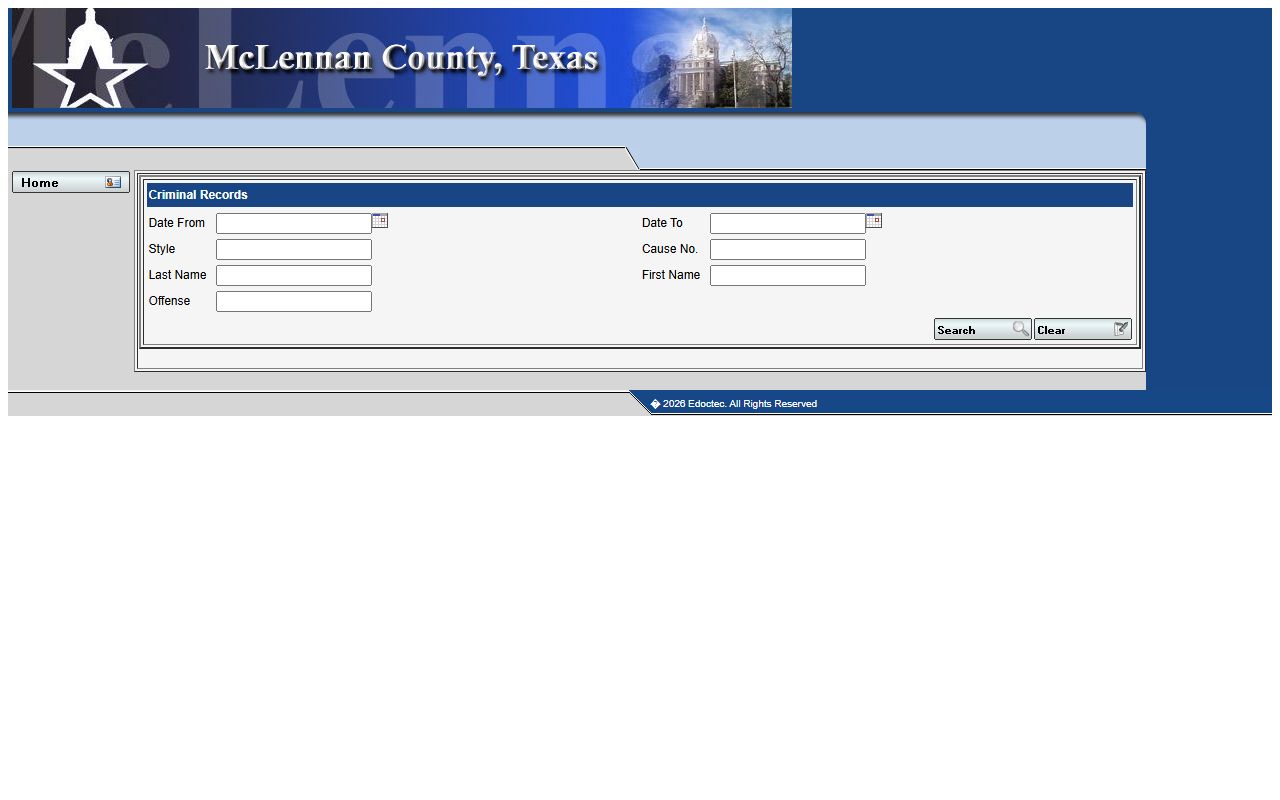
The search page can help identify the case, but it does not replace the clerk's file. If the case is old, missing, sealed, recently filed, or too broad to find by name, the District Clerk or County Clerk access channels become the safer route.
McLennan Court Search Fields
The McLennan County criminal records search form uses a classic case-index layout. Start broad when the arrest is recent or when the cause number is not known. A last-name and first-name search is usually the most flexible first pass. Add a date range or offense only when results are too broad. If the jail or mugshot record lists a booking number but not a cause number, the court search still usually needs a name, date, or offense search.
| Field Label | Type | Required | Options / Format Notes |
|---|---|---|---|
| Date From | Text or date picker | Unspecified | Calendar icon opens the date picker field. |
| Date To | Text or date picker | Unspecified | Use with Date From to narrow a filing or event range. |
| Style | Text | Unspecified | Party or case-style search field. |
| Cause No. | Text | Unspecified | Best field when the court cause number is already known. |
| Last Name | Text | Unspecified | Defendant or party last-name search. |
| First Name | Text | Unspecified | Use with Last Name to reduce unrelated matches. |
| Offense | Text | Unspecified | Useful when the booking offense is known. |
| Search | Image button | Not applicable | Runs the search. The inspected button alt text references Land Records Search though the page is criminal records. |
| Clear | Image button | Not applicable | Clears the form fields. |
A default digital date can be misleading. The District Clerk notice says a 01/01/1900 date may appear when the digital record lacks the true date. Treat that kind of date as an index artifact, then verify with the clerk before relying on it for deadlines, background checks, or case history.
Find Charges After Arrest
The court-record search works best when the booking information is used as a lead, not as the final answer. A mugshot or inmate entry may show an initial offense from intake. The prosecutor may later file a different charge, decline a charge, reduce a charge, add a new count, or present the case to a grand jury. That is why McLennan County court records after arrest should be checked through the court index and the correct clerk office.
- Use the sheriff's current inmate listing or mugshot application first to identify the person, booking date, offense, booking number, CID, and case agency.
- Search the criminal records portal by last name and first name. Add date range or offense text if the name returns too many matches.
- Use Cause No. when a court cause number is known. It is the narrowest search field.
- Open the matching case index and compare the court charge to the booking offense. They may not match word for word.
- For older, unavailable, or unclear records, contact the District Clerk for felony-level district court files or the County Clerk for county-level misdemeanor files.
Texas public access rules provide the broader framework. The Texas Public Information Act is in Government Code Chapter 552. Basic information about an arrested person, arrest, or crime remains a key public-access category even when some law-enforcement material may be withheld. Court records, however, are not the same as jail files. Filed criminal cases must be checked through the court portals and clerk channels tied to that court level.
McLennan Charging Documents
The Criminal District Attorney's Office is the local prosecutor that turns accepted arrests into filed criminal cases. The court record may begin with a complaint, information, or indictment, depending on the charge and stage. A complaint can support arrest or magistration. An information can charge certain offenses without an indictment. An indictment is a grand-jury charging instrument and is central to many felony prosecutions.
| Document | Who Uses It | What It Does | Local Caveat |
|---|---|---|---|
| Complaint | Officer or prosecutor | States the accusation and can support arrest, magistration, or early case handling. | It may not be the final filed charge that appears later in court. |
| Information | Prosecutor | Charges certain criminal cases without grand-jury indictment. | Check the clerk record for amendments or later dispositions. |
| Indictment | Grand jury | Formally charges many felony cases after grand-jury action. | McLennan County notes that an indictment may be sealed if the person is not under arrest when indicted, then updated after apprehension for arraignment. |
The county's hearing-list notice adds another local limit. If the McLennan County Criminal District Attorney has not filed the case, it will not appear in criminal lists maintained by County Courts at Law. A missing court listing right after booking may mean the case has not been filed yet, not that the arrest never occurred.
McLennan Charge Status
Charge status is the main reason to check court records after a jail arrest instead of relying only on a booking entry. Booking charges can be preliminary. Court charges can move through several stages as the prosecutor reviews reports, lab results, witness information, prior cases, bond conditions, and grand-jury action. A case may also have more than one count, with each count at a different stage.
| Status | What It Means | How to Read It |
|---|---|---|
| Pending | The filed case or charge remains open. | Look for upcoming hearings, bond conditions, and later amendments. |
| Amended | The filed charge has been changed from an earlier form. | Compare the amended charge to the booking offense and earlier court entries. |
| Reduced | The filed offense level or charge has been lowered. | A reduction is still a court action, not proof of dismissal. |
| Dismissed | The court case or count has been ended without conviction on that charge. | Dismissal does not automatically erase every public record of the arrest. |
| Rejected or not filed | The prosecutor did not file the charge shown at booking. | The jail record may still exist unless restricted by law or court order. |
| Indicted | A grand jury returned an indictment. | Check whether the indictment was sealed before apprehension and later updated. |
Clerk and DA Access
McLennan County has separate access channels because felony-level court files, county-level misdemeanor files, and prosecution questions do not all sit in one office. The District Clerk handles district-court access and criminal-record search services listed for that office. The County Clerk handles county-level misdemeanor case access. The Criminal District Attorney's Office is the prosecutor, so it is tied to filed-charge decisions, amendments, rejections, indictments, and prosecution status, but it is not a substitute for a clerk-certified record.
| Channel | Use For | Contact / Place | Fees or Access Notes |
|---|---|---|---|
| District Clerk | Felony-level district-court criminal files, record searches, certificates, viewing case files, copies, and filing. | Ralph Strother, 501 Washington Avenue, Suite 300, Waco, TX 76701. Criminal Division: 254-757-5054. Monday-Friday, 8 a.m.-5 p.m. | Phone name/DOB criminal search: $5. Criminal research letter: $5. Certified criminal research letter: $10. Copies: $1/page. Major credit cards accepted for phone search. |
| County Clerk | County-level misdemeanor criminal cases and county criminal-search letters. | County Clerk criminal case pages direct court-date questions to the Court Administrator at 254-757-5030. Felony questions go to the District Clerk at 254-757-5054. | Criminal searches: $5/name. Criminal search letters: $5. Copies: $1/page. Certified copies add $5/case. |
| Criminal District Attorney | Prosecution status, filed-charge context, amendments, rejections, indictment path, and procedural direction when the issue is what happened after arrest. | 219 N. 6th Street, Suite 200, Waco, TX 76701. Phone: 254-757-5084. Monday-Friday, 8 a.m.-5 p.m.; closed noon-1 p.m. | No public copy-fee schedule was identified in the research for DA contact. Certified copies and record searches should be requested from the proper clerk. |
District Clerk mail requests should include the full name, date of birth, case number if known, payment by check, money order, or cashier's check payable to McLennan County District Clerk, and a self-addressed stamped envelope. County Clerk mail requests should include name, identifiers such as date of birth, return address, and phone number. The County Clerk Tyler portal also warns that the online index is a guide, not a certification, and that spelling variations may be needed.
Bond and Warrant Records
Bond information often appears close to the arrest-to-court transition. Texas bail is governed by Code of Criminal Procedure Chapter 17. In practice, bond can be set by a magistrate after arrest, by a court, or under local rules for eligible charges. McLennan County's bond materials state that the original, copy, and money order must be presented to the Bond Clerk at the same time. The county also publishes bail-bond forms and posting rules.
Bond status may differ by charge. A person may have a cash bond, surety bond, personal recognizance bond, property bond, or no-bond hold. Holds can prevent release even when another charge has a listed bond. Research examples include a parole blue warrant, a hold for another county, a federal hold, an ICE detainer, or a no-bond warrant. The mugshot app arrest-offense detail can show BondType and Bail, while the court record shows what the court does with the case after filing.
No single official McLennan County sheriff active-warrant search was confirmed in the inspected sources. The official warrant contact located in the research is Sheriff Parnell McNamara's Warrant Division at 254-757-5107. Warrant fields can also appear in the mugshot application after a person is booked. For a court case with bench-warrant history, search the criminal records portal by name, cause number, date range, or offense, then verify with the correct office before acting on the information.
Charge vs Conviction
A McLennan County court record after arrest may show a charge long before it shows a conviction. A charge is an accusation filed in court. A conviction is the result of a guilty plea, verdict, or other final judgment that establishes guilt under the criminal process. Treating a charge as a conviction is one of the most common record-reading mistakes.
| Point of Comparison | Charge | Conviction |
|---|---|---|
| Meaning | An accusation filed or pursued in court. | A final result based on plea, verdict, or judgment. |
| Timing | Can appear soon after arrest or after prosecutor review. | Appears after court action resolves guilt. |
| Proof Level | May begin from probable cause, complaint, information, or indictment. | Requires the legal standard for conviction through plea or trial. |
| Public Meaning | Shows what was alleged or filed. | Shows the final criminal finding or accepted plea. |
| Record Risk | Can be amended, reduced, dismissed, or not filed as first booked. | May affect sentencing, supervision, custody transfer, and criminal-history records. |
Sealed vs Expunged
Texas law separates public access, nondisclosure, and expunction. Expunction is addressed in Code of Criminal Procedure Chapter 55A. Nondisclosure and criminal-history limits are addressed through Government Code Chapter 411. A dismissal, acquittal, or other favorable result does not, by itself, guarantee that every arrest-related record is removed from public access. A court order or specific legal process may be needed.
| Point of Comparison | Sealed / Nondisclosed | Expunged |
|---|---|---|
| Basic Effect | Limits public disclosure of eligible criminal-history records. | Treats eligible arrest records as removed under the expunction order. |
| Public Search Impact | Some public-facing access may be restricted. | Records subject to the order should not remain publicly available in the same way. |
| Agency Access | Certain agencies may still have limited access under Texas law. | Access is more sharply limited, subject to the order and statute. |
| Common Trigger | Eligible criminal-history record after qualifying disposition. | Eligible arrest record after qualifying result or statutory condition. |
| Practical Step | Check the court order and clerk record before relying on online results. | Use the District Clerk expunction information and court order process. |
McLennan County's District Clerk expunction information notes local handling for expunction requests and agency transmission. Because eligibility depends on the exact case history, charge, and disposition, court records after a jail arrest should be read with care when a case has been dismissed, reduced, sealed, nondisclosed, or expunged.
Restricted McLennan Court Records
Public access is broad, but it is not unlimited. Juvenile matters, sealed indictments, expunged arrest records, nondisclosed criminal-history records, and some active law-enforcement materials may be restricted. McLennan County's grand-jury material adds a specific point: if a person is not under arrest when indicted, the indictment is sealed until apprehension for arraignment. After apprehension, the file is no longer sealed and previously sealed indictment files are updated.
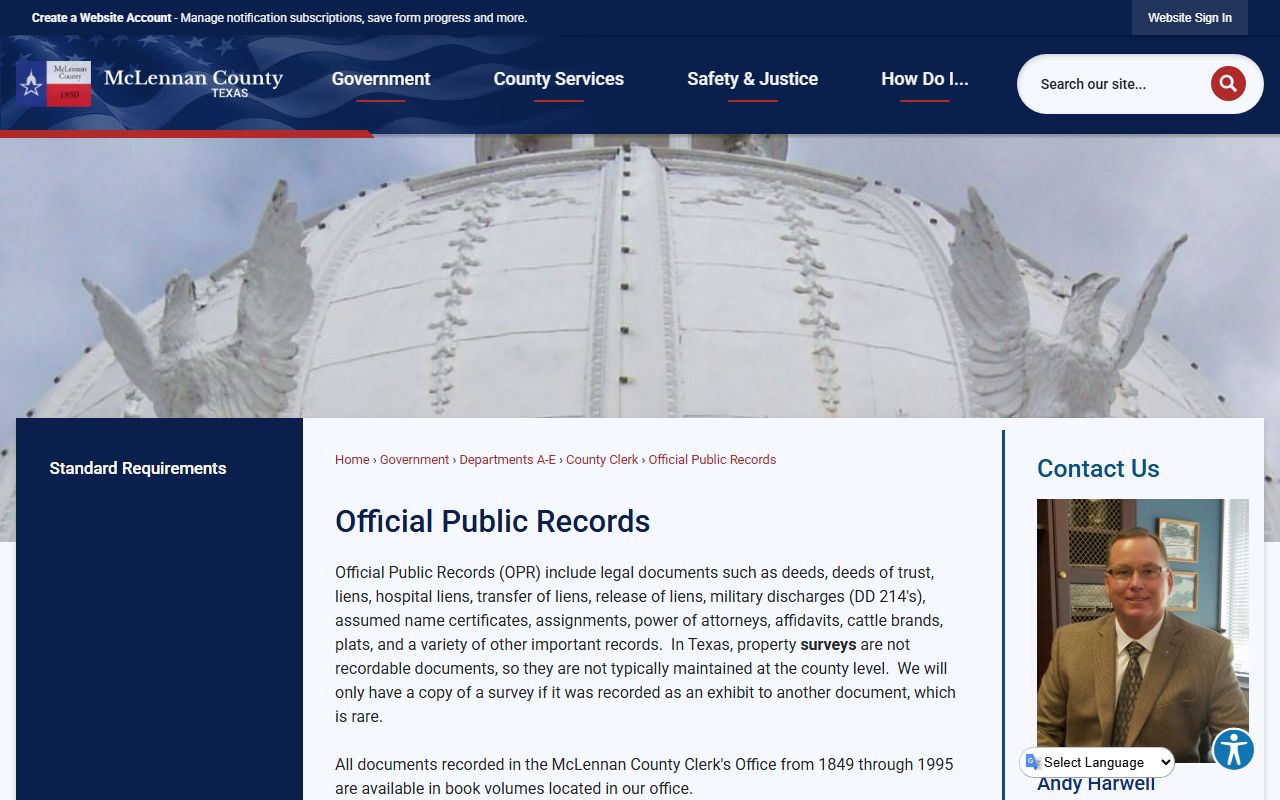
The Criminal District Attorney's Office page is a useful source for prosecutor context because it identifies the office responsible for felony-level criminal prosecution and related matters. The image below is from the McLennan County Criminal District Attorney's Office page.
For public-record requests outside the court index, the sheriff's GovQA portal and records phone line are the local fallback for sheriff records. For court-file certification, use the clerk. For prosecution questions, use the District Attorney. Keeping those channels separate prevents the most common mistake in McLennan County arrest research: treating a jail booking line as the final court record.
Important: Public-record information is not a consumer report and may not be used for FCRA-covered employment, tenant, credit, or insurance screening.